

Conflict & Peace
Bravery, selfless service and sacrifice…these are worthy of our honor and respect. But the ugliness of war should never be glorified.
*This article is a guest written piece.
There is no denying that we live in a world marked by conflict.
Did you know that there are currently 4 major conflicts/wars that have resulted in 10,000 or more deaths per year for the last two years?
Consider that in 2017 the conflict in Syria resulted in over 39,000 deaths, the Mexican drug conflict resulted in nearly 15,000, the war in Afghanistan 14,000, and the war in Iraq over 13,000.
Then consider the rest of the world and places like Myanmar, the Philippines, Ethiopia, and Somalia plus 10 other countries where armed conflicts have resulted in casualties between 1,000 and 10,000 people in the last two years alone.
Let this fact sink in for a moment…there were 15,590 people killed by guns in the United States last year not including gun deaths by suicide.
What does all of this death lead to?
Thousands upon thousands of funerals. Mothers and fathers who weep uncontrollably, lives cut far too short, communities torn apart, neighbors turned into enemies, hearts hardened and lives imprisoned by fear.
Let’s face it: it is really hard at times to not get caught up into the narrative of fear.
It can be difficult for us to resist the world’s story that sows mistrust in others and encourages us to circle the wagons and live in a posture of defensiveness.
At times, we might even try to shut the rest of the world out and live in a pseudo-safe cocoon-like environment where we are surrounded by comfort and quarantined off from the problems of the “world”.
The Journey of Peace

Even though it was 11 years ago, there are many days when it feels like just yesterday: when getting dressed in the morning included putting on a full set of body armor strapped with loaded magazines and picking up my rifle for another day in the life of a soldier serving in Operation Iraqi Freedom.
There are many aspects from my life as a soldier that I miss everyday. The camaraderie with the men and women I served alongside. The shared sense of struggle and unique bonding that occurs when people face adversity together, and the feeling of exhaustion after a long day of work.
However, there are other aspects of my life as a soldier that I do not miss.
I do not miss carrying around a weapon of war to the bathroom and dining hall.
I do not miss living in a perpetual state of fear, wondering if the worst is about to happen to someone I love.
I do not miss looking at others with constant suspicion of their motives.
I do not miss the look on people’s faces after they have suffered unthinkable tragedies.
I do not miss the toxic culture surrounding combat that entices anger, bitterness, and hatred within the human heart.
I do not miss being separated, both physically and emotionally, from family and friends.
I do not miss war.
I do not understand a culture that glorifies the brutality of war.
Bravery, selfless service and sacrifice…these are worthy of our honor and respect. But the ugliness of war should never be glorified. I will never understand the culture of fascination that surrounds weapons of war and treats them like accessories to one’s life, for I know these are nothing more than tools of destruction that reflect the ugliest part of our humanity.
I refuse to worship war and all of its tools and instruments. I refuse because I have been called to follow the Prince of Peace.
It is for times such as these that we have been called.
As Christians, we need to be careful not to confuse the “absence of conflict” with peace. True peace for the Christian is not understood as being found in perfect harmony or serenity, but rather, peace is to be understood in a twofold manner. 1) As the very presence and being of God. 2) Peacemaking as a ministry of reconciliation.
PEACE FOUND IN THE PRESENCE OF GOD.
The biblical words for peace, shalom (Hebrew) and eirene(Greek), both convey the understanding that God is the very source of peace. It is God’s presence with us in the valley of the shadow of death that brings peace, not the green pastures or still waters.
Consider the words from the Apostle Paul:
“Not that I am referring to being in need; for I have learned to be content with whatever I have. I know what it is to have little, and I know what it is to have plenty. In any and all circumstances I have learned the secret of being well-fed and of going hungry, of having plenty and of being in need. I can do all things through him who strengthens me.”Philippians 4:11-13
And the blessing of Aaron:
“The Lord bless you and keep you;
the Lord make his face to shine upon you, and be gracious to you;
the Lord lift up his countenance upon you, and give you peace.” Numbers 6:24-26
Galatians reminds us that peace is a fruit of God’s very Spirit:
“By contrast, the fruit of the Spirit is love, joy, peace, patience, kindness, generosity, faithfulness, gentleness, and self-control. There is no law against such things.” Galatians 5:22-23
God’s abiding hope and presence in our lives is the ultimate source of real peace.
Peacemaking As a Ministry of Reconciliation
The Christian life is one that is always being made new. The Holy Spirit is continually pursuing us and inviting us to live into God’s narrative of healing, forgiveness, and sense of wholeness (shalom).
The Letter of Paul To The Galatians reminds us that we have not only received a calling to “live like Jesus” or to “love like Jesus”, but that Jesus lives inside of us.
“And it is no longer I who live, but it is Christ who lives in me.”Galatians 2:20
The Christian life is not a matter of behaving like Christ, but of allowing Christ himself to live in and through us, and here’s the thing about Jesus: he is always inviting us to join him in the ministry of reconciliation and peacemaking.
“Therefore if anyone is in Christ, they are a new creation. The old has passed away; behold, the new has come. All this is from God, who through Christ reconciled us to himself and gave us the ministry of reconciliation; that is, in Christ God was reconciling the world to himself, not counting their trespasses against them, and entrusting to us the message of reconciliation.” 2 Corinthians 5:17-19
“Blessed are the peacemakers, for they shall be called children of God.” Matthew 5:9
The church embodies the very peace of God when we embrace our foundational purpose of bearing witness to the resurrection of Christ that leads us to seek peace in all areas of our society and around the world.
Living in the 21st century world we will certainly still hear the voices of fear, discord, and division that are ever present in our lives, but they cannot motivate us, because we are followers of Jesus.
As citizens of the global world, we will be tempted to choose “sides”, fan the flames of tribalism, and circle the wagons, but we must resist because we are agents of reconciliation.
As individuals, we will be tempted to build our own kingdoms and serve our own interests, but we must seek first the kingdom of God because we are servants of all.
When we choose peace over conflict we model the very essence of Christ to a hurting and broken world.
Rev. Lorne Hlad
Lorne served in Operation Iraqi Freedom in 2006-2007, and currently serves as pastor to Prince of Peace Lutheran Church in Loveland, OH

USAMERICA'S GUN CULTURE AND THE CHURCH'S WITNESS - PART II
The alliance of faith, patriotism, and guns is not of Jesus. It is of Constantine.

GOD, COUNTRY, FREEDOM, AND THE RIGHT TO BEAR ARMS
Dana Loesch, former writer and editor and spokesperson for the NRA, tweeted out this message on Monday morning, May 7th:
New record attendance for #NRAAM: 87,154 law-abiding attendees over the three-day weekend in Dallas. #2A
The NRA had just completed it’s annual meeting in Dallas. President Trump and VP Pence were among the many well-known people in attendance. It is important to remember that the NRA contributed $11,438,118 to the 2016 Trump campaign. The Huffington Post reports that the NRA spent a total of $419 million during the 2016 election year.
YOU JUST CAN’T MAKE THIS STUFF UP!
A significant constituency at the meeting were those identifying as Evangelical Christians. Sunday morning’s prayer breakfast was telling in terms of the enmeshment of evangelical faith and guns. Former all-star MLB player, Adam LaRoche, was giving a testimony. 15 minutes into it he took off his sweater to reveal a black tee shirt that read:
Jesus loves me and my guns.
The attendees gave their loud acclamation. Oliver North – yes, that Oliver North, controversial figure from the Iran contra-affair and political conservative – is the heir apparent to lead the NRA. In a rousing 45-minute speech he mixed faith and guns as the divine birthright of American freedom. Joe Gregory, a charter member of the NRA’s Golden Ring of Freedom, which consists of donors who give $1,000,000 or more to the NRA, opened the breakfast with this prayer:
Lord, we put our faith and trust in you and not in governments or militaries or our own technology or even the strength of our own arms. Still, we humbly ask you to direct and bless our efforts against those who would seek to take away those freedoms. Empower us to protect the peace of our homes and ensure the safety of those defending the homeland overseas and deliver us from despots of tyranny.
When the breakfast was over, a reporter asked an organizer why there were no prayers for those killed by gun violence and no mention of the mass shootings. The organizer replied, “It must have been an oversight.”
And so it was – God, country, freedom, and the right to bear arms. Any attempt to challenge that covenant is seen as coming from the Evil One. Keynoter LaRoche reminded everybody that Jesus said in Matthew 10:34,
I did not come to bring peace but a sword.
A STUBBORN STATUS QUO
Since February 14 when Nikolas Cruz opened fire on students at Marjorie Stoneman Douglas High School in Parkland, Florida, killing 17 and wounding 17 more, making it the deadliest school massacre, we have seen movements rise up all across this country. There have been social media campaigns, organized marches, school walk-outs, mass marches on Washington, testimonies before congress, heart-rending speeches by kids from Parkland, and pleas from other victims of gun violence to our elected leaders to do something. This country has seen the largest ground swell of protests against gun violence and current gun laws since December 14, 2012, Adam Lanza fatally shot 20 children, ages 6 and 7, at Sandy Hook Elementary in Newtown, Connecticut. The results of the protests and the outrage this time around is about the same after all the noise following Sandy Hook died down. Basically, no change in the status quo.

USAMERICA IDOLATRY – GUNS ARE OUR GOLDEN CALF
When it comes to a love affair with guns, USAmerica’s gun culture is certainly an outlier among developed countries and even among all. Consider these sobering facts:
- Worldwide, there are an estimated 650 million civilian-owned guns. The U.S. population is 5% of the world population; yet, USAmericans own 48% of all guns. That’s almost 50%!
- In terms of private gun ownership, the top ten per capita gun-owning countries are: U.S.A., Yemen, Switzerland, Finland, Serbia, Cyprus, Saudi Arabia, Iraq, Uruguay, and Sweden. The U.S. has 90 guns per 100 people. 10th place Sweden has 31; thus, per capita gun ownership in the U.S. is 3 times that of Sweden. 2nd place Yemen has 55 guns per 100 people. In other words, gun ownership in the USAmerica is 64% higher than in 2nd place Yemen!
- The homicide rate by firearm in USAmerica is such an outlier among developed countries that our homicide rate is almost 4 times that of 2nd place Switzerland and over 21 times the rate in Australia.
- Annual deaths by gun violence for persons 15-29 now exceed deaths in vehicle-related deaths, 11,947 versus 10,881 (2016). Only deaths by drugs exceeds deaths by firearms.
- From 1966 to 2012, USAmerica ranked number one in mass shootings with 90. A mass shooting is defined by 4+ victims, not counting the shooter. The Philippines was 2nd with 18, followed by Russia with 15, Yemen with 11, and France with 10.
- Mass shootings for 2014 = 100. 2015 = 135. 2016 = 142. 2017 = 154. 2018 is on pace to break 2017’s pace.
- As of April 20, 2018, on the 19th anniversary of “Columbine,” there had already been 20 school shootings in USAmerica. That’s 1.25 per week.
- From 1982 until the present, 79% of the killers in mass shootings obtained the weapons legally.
- The general weapon of choice in mass shootings is an AR-15 or equivalent.
- How many assault rifles are in the United States? We do not know. Lobbying by the NRA has prevented there being a gun registry in USAmerica.
AN INCONVIENIENT TRUTH OR A DIRTY LITTLE SECRET
Mass shootings are primarily a white male problem. Since 1982, women represent half of the casualties in mass shootings; yet, only three mass shootings were perpetuated by a woman. And the race of the males is almost overwhelmingly white. So the perpetrators of these hideous crimes of mass carnage are not the “murderers, rapists, and criminals” coming from “shithole countries.” They are white USAmericans. If they were of another ethic group, then there would have been long ago the labeling of the them as “terrorists.” But because they are white males we choose to focus on things like mental health rather than the heart of the matter. The United States does not have the market cornered on mental health issues; nor do men.
WHY?
So why are white men committing mass murders? Is it because of a catastrophic sense of male entitlement that drives the desire to kill? 30% of mass shooting occur in the workplace. Is it anger at them, or those people who are taking over our country? And what about those who murder in our schools? What is the anger and entitlement that drive them?
Whatever the reason there is no denying that we have a culture in this country that worships men with guns.

THE CHURCH’S WITNESS
The alliance of faith, patriotism, and guns is not of Jesus. It is of Emperor Constantine. Stay tuned for the next blog when I will explore the church’s witness in the midst of our gun culture.
In the abiding hope of the empty tomb,


The Rare & Necessary Leader
The gift of the adaptive leader is the capacity to facilitate transformation in others, that is, the adaptive leader midwifes the adaptation and embrace of others to change.

There are young ones and more seasoned ones.
They come in all genders – male, female, LQBTQIA.
They may be brown, white, black, and come from any number of ethnicities and nationalities.
They cover the entire political spectrum and may identify with any socio-economic classification.
They have differing levels of education.
What they all have in common is a gift, and that gift makes them outliers among leaders.
The gift is the capacity to so influence others that they bring about true transformation (as opposed to pseudo-transformation) of people or systems of people - the kind of needful transformation for which life and the world hunger.
This rare and necessary leader may enter a minimally performing organization that has a toxic culture of infighting, backbiting, duplicity, entitlement and the like and bring about not just a changed organization but also an organization that is new. It is new in its vitality, life-giving culture, and the effectiveness and clarity with which it goes about its mission and achieves its vision.
This rare and necessary leader may be called to a congregation that has been in years of decline, marked by conflict, inward focus, and has a history of chewing up and spitting out pastors who dared to change things; and, yet this leader with the gift and the right spirit is able to midwife the emergence of a new congregation that is vibrant, externally focused, birthing new life to those a part of it and impacting the culture and world around it.
Persons who have been influenced by this leader with the gift often say things like, “I never knew church could be like this,” or “We have totally reordered our lives in light of the gospel, are striving to live intentionally, have discovered that we are exponentially more generous than before, and we love our newfound lives!”
Who is this rare and necessary leader?
We know it when we have entered such a leader’s sphere of influence. We recognize such a rare leader not only in the church, business, and the non-profit world but also in politics and public life.
Leadership gurus call this particularly gifted one, “The Adaptive Leader.”
Before going further here, let’s clarify a misperception of the meaning of adaptive leadership. When many hear the term, “Adaptive Leader,” they presume, “Oh, this is someone who is really adept at adapting to change.” Though being nimble in adjusting to change is a desired trait in any leader, this is not the gift of the adaptive leader.
The gift of the adaptive leader is the capacity to facilitate transformation in others, that is, the adaptive leader midwifes the adaptation and embrace of others to change.
In the big picture of things, an adaptive leader then brings about a change of worldviews – a change of paradigms through which people and systems understand themselves.
It facilitates persons abandoning long-held beliefs and strongly-held loyalties in order to be grasped by and give themselves to a new set of loyalties and beliefs.
When Jesus called people to “repent,” he wasn’t asking them to feel bad about themselves. He was asking them to reconstruct their minds – to see things entirely differently because a new day, a kairos time. God is on the scene.
Adaptive leadership re-stories people and communities, enabling them, in biblical language, to die to one way of self-understanding with its assumptions and priorities and to rise to a new life.
Of course, adaptive leadership that is midwifing a change of worldviews, especially those that challenge long-held beliefs or we-have-always-done-it-this-way cultures is a perilous undertaking.
Ask Galileo, or ask Martin Luther King, Jr, or ask Jesus of Nazareth. But the drive and passion of an adaptive leader overrides the perils because the change vision is so worthy that failure to achieve the outcome is not an option.
So, let’s look at five defining traits of this rare and necessary leader:
Embodying a conviction of the spirit.
An adaptive leader sees a situation and is so internally convicted that the drive to transform it burns deeply inside. The one with the gift sees a vision of what is possible and puts one’s own life on the line to achieve it.
The leader is so consumed by the vision that she eats, sleeps, and dreams it. There is very little reprieve from the consistent dwelling in the vision that needs to be achieved.
Because others do not share in the same internal burn, the authentic adaptive leader is often misunderstood. This means that the adaptive leader will find herself to be lonely; yet, the fire within burns.
Courage.
The adaptive leader needs that internal burn because she or he will almost certainly be attacked by others.
Albert Einstein once said, “Great spirits have always encountered violent opposition from mediocre minds.” The adaptive leader knows that what Einstein calls “the mediocre mind” is incapable of understanding one who refuses to bow down to the status quo and its prejudices.
It is almost certain in today’s wired world that a bold adaptive leader is going to experience anonymous attacks on social media and sabotage from those most threatened. But the adaptive leader has grit.
And in the face of nay-sayers, saboteurs, and even those who make up lies to smear the change-agent, the adaptive leader has an internal conversation that says, “Just be big. Do not get sidetracked. Don’t lose your focus or drive.”
Inspiration.
The primary tools of an authentic adaptive leader are vision and inspiration.
The leader is internally inspired and influences transformation through inspiration. This means that the adaptive leader inspires rather than manipulates people.
The one with the gift leads not by controlling people but by unleashing them. Choosing transformational leadership over transactional, the leader invests in people rather than manage them, and deploys them as opposed to a quid pro quo employed relationship.
A Differentiated Self.
The drive and focus of an adaptive leader are so clear that there will certainly be others who will judge the leader as being harsh or arrogant.
Ed Friedman in his manuscript, A Failure of Nerve, delves deeply into this. The adaptive leader is a human, and humans want to know that they are loved and valued; yet, the adaptive leader is able to differentiate the self and overcome people-pleasing urges because of the drive of the convicted spirit to achieve the sought-after transformation.
Enthusiasm.
Ralph Waldo Emerson once wrote, “Nothing great was ever achieved without enthusiasm.”
Despite the great challenges associate with inspiring and driving change through all the hurdles and pushback, the adaptive leader embodies enthusiasm and a joy that are contagious.
In Haiti, persons of faith struggling to effect change rise with a song in their hearts, Sa se yon jou grammet la te fѐ. “This is the day the Lord has made.” This day – right here, right now – is not a dress rehearsal for another day. This day is the real thing. So, let us rejoice and be glad in it!
To those of you called to lead, knowing the high stakes of this day, be reminded of the words attributed to the Apostle Paul in Ephesians 4:
I beg you to lead a life worthy of the calling to which you have been called…
In the abiding hope of the empty tomb,

Our Gun Culture And The Church's Witness - Part 1
Where is God?
We spoke about the falling rain as a sign of a God weeping over the senseless slaughter of his innocent children. After all, God is the first to cry. We also spoke of the falling rain as a sign of baptismal promises. Sealed by the Holy Spirit and marked with the cross of Christ forever, the worst thing that could ever happen to us will not be the last thing.

April 21, 1999, Littleton, Colorado - The First Day after “Columbine”
Through falling rain under a dreary evening sky, they came.
They came into the worship center clutching and hanging onto each other. They hung their soccer t-shirts and other sportswear identifying them as Columbine High School students over the communion rail. Three young ladies put their high school yearbook on the altar. Our worship center was filled to overflowing a half hour before the service would start. Standing room only awaited the later arrivals, and yet they kept coming.
We sang,
God of grace and God of glory on your people pour your pow’r…
Cure your children’s warring madness, bend our pride to your control…
Save us from our wonton gladness, rich in things and poor in soul…
Grant us wisdom. Grant us courage for the facing of this hour…
We also sang,
A mighty fortress is our God…
Though hordes of devils fill the land all threatening to devour us…
Were they to take our house, goods, honor child or spouse,
Though life be wrenched away, they cannot win the day…
Where is God?
We spoke about the falling rain as a sign of a God weeping over the senseless slaughter of his innocent children. After all, God is the first to cry. We also spoke of the falling rain as a sign of baptismal promises. Sealed by the Holy Spirit and marked with the cross of Christ forever, the worst thing that could ever happen to us will not be the last thing.
We spoke of a God who so incarnates with the human predicament that Jesus took a bullet in the school.
A forgotten detail about the Columbine shootings is that the slain students spent the night on the floor of the high school because of the difficulty of moving bodies in a booby-trapped environment.
Informed by a theology of the cross, we proclaimed that Jesus also laid there with them. Of course, we also know the outcome of the Jesus story, and the outcome of the Jesus story is also our outcome. The tomb is empty. Jesus is risen. And because Jesus is risen we also will rise, meaning that love and life finally win.
BC and AC
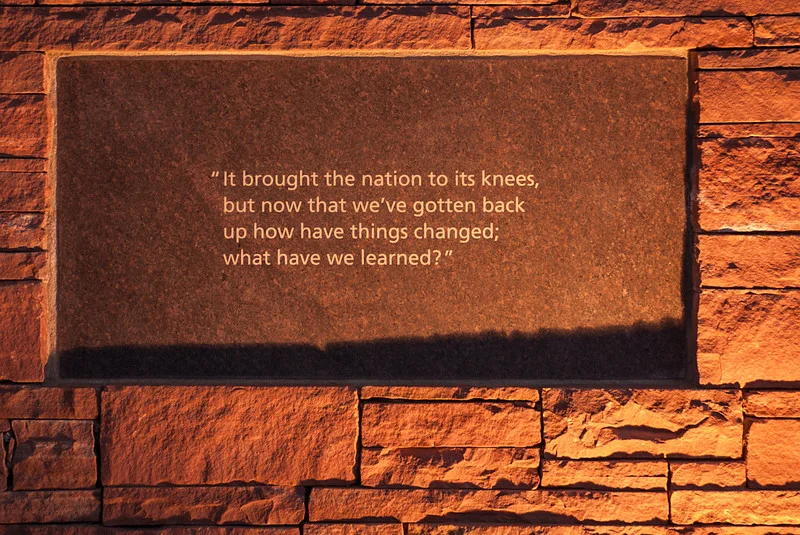
In the days and weeks following Columbine and as congregations and people of faith worked to heal our community, we became totally convinced that the experience of “Columbine” would so shock us and so move us that we would one day speak of time as BC and AC. Before Columbine and After Columbine.
Surely the easily availability and evil use of guns, surely the sights and sounds of children being murdered, families being shattered, and a community in deep mourning would rattle us into being made into a new culture. Wishful thinking.

Photo: Columbine Memorial Littleton, Colorado
Spiritual Warfare and the Idolatry of the Gun Culture
Put on the whole armor of God, so that you may be able to stand against the wiles of the devil.
For our struggle is not against blood and flesh, but against the rulers, against the authorities,
against the cosmic powers of the present darkness, against the spiritual forces of evil…
-Ephesians 6:11-12
Since that awful day on April 20, 1999, there have been more than 200 school shootings in the United States. That’s right. Over 200. Columbine no longer holds the hideous distinction as the deadliest school massacre in U.S. history. And schools represent only a piece of the story.
Beyond the schools there was Blacksburg, Aurora, Las Vegas, Orlando, Charleston, Sutherland Springs, and countless more. Of the 30 deadliest shootings in the US dating back to 1949, 18 have occurred in the last 10 years. Two of the five deadliest took place in just the last 35 days.
We have an entire generation of young people who have grown up in a violent gun culture; some call them the “Columbine Generation.” Yet the availability of guns, especially weapons for military purpose, goes unabated.
Part of the NRA’s agenda is to be sure that the next generation has its own allegiance to a gun culture. From 2010 through 2016, the NRA gave $7.3 million to about 500 schools for use in programs that promote the use of firearms.
The November 8th edition of The Christian Century featured a shocking graph titled “American Exceptionalism.” It illustrates the United States as a pronounced outlier among other countries in terms of homicides by firearms.
One is almost six times more likely to be murdered by a firearm in the U.S. than in Canada, eleven times more likely than in Denmark, and twenty-one times more likely than in Australia.
A Confession for This Day
After Parkland and hearing the rhetoric of the culture – including students calling BS on much of what was being said and the impotent expressions of “thoughts and prayers” – I imagined that we needed a new Lenten Confessions. After all, Parkland happened on Ash Wednesday (as well as Valentine’s Day).
Almighty God to whom all hearts are open, all desires known, and from whom no secrets are hid we confess that we are in bondage to a gun culture and cannot free ourselves.
Rather than address the heart of the matter, our idolatry, we deflect the matter by making the issue about mental health or about stronger background checks, or about arming teachers in our schools.
We point fingers at those who failed or should have done something.
We speak of the 2nd Amendment as a God-given right, even to the point of making the right to have almost any kind of weapon a fundamental value of what makes America great.
And those of us who do not believe in the prevalent interpretation of the 2nd Amendment as an anything goes right to have whatever arms one can buy, especially pastors and politicians, we confess our fear to speak our mind.
The pastor fears the wealthy parishioner who disagrees and who will walk out.
The politician fears the NRA.
Gracious God, have mercy on us.
Assist us to think differently.
Assist us to see what we cannot see, dream what we would not dare dream and to work for an alternative culture in which we beat our assault rifles into ploughshares and our hand guns into pruning hooks and gun violence shall be no more. Amen.
Stay tuned for more…
In the abiding hope of the empty tomb,


What Might We Learn?
As I still try to process the words spoken in January by the leader of the free world that dismissed people of certain countries, I think of my greatest teachers. They have been the courageous, joyful, hopeful, and tenacious people of Haiti, people who have kept on keeping on and moving forward against the longest of odds.

A trait that I value in persons who would be leaders of people and even leaders of leaders is “teachability.”
Great leaders are always seeking to learn from others and have coaches and others who can provide valuable feedback. As one wise person once said, “Feedback is the breakfast of champions.”
Great leaders are always evolving and look to reinvent themselves for the changing landscape and parameters of the context within which they lead and the world around them.
As I still try to process the words spoken in January by the leader of the free world that dismissed people of certain countries, I think of my greatest teachers. They have been the courageous, joyful, hopeful, and tenacious people of Haiti, people who have kept on keeping on and moving forward against the longest of odds.
A few weeks after that awful day of January 12, 2010 when the earth shook in Haiti, killing over 350,000 persons, displacing many times more, and creating over a million new orphans, I was privileged to preside at the funeral of two remarkable young people, Marc Erline and Evenson, students in the Haitian Education and Leadership Program (uhelp.net), an awe-inspiring program that has as its most long standing continuous supporting partner the Haitian Timoun Foundation (htflive.org).
This program invites the very brightest young people in Haiti who have no way to fund a college education and provides for such an education including tuition, housing, food, leadership development and much more.
The hundreds of young men and women who have graduated from this program or are in it now truly represent the very best in terms of leadership and leadership potential.
They have overcome incredible hardships and obstacles – no electricity, miles to the nearest school, inadequate nutrition, and generally only a mother or grandmother as a parent – to not only graduate from high school but to also be ranked number one in their class.
In a country where 85% of all people holding a college degree do not live in Haiti, these young people who are integrated into the H.E.L.P program have a deep desire to take their learning and invest themselves in Haiti, making it better and more just.
On this day of the funeral, the grief in the makeshift worship space under a tarp in the mid-day Port-au-Prince sun filled the air with the sounds of mourning and the shock of what had happened.
Haiti is a cruel place where the best dreams can be smacked down.
Marc Erline and Evenson, both killed in the earthquake, were amazing young people who brought joy, light, and excellence to every group they entered.
The reality on this day was not that an earthquake had taken their lives. Poverty had.
It is the kind of poverty where a country mired in it is exploited by exporters of cement who can sell expired cement to them and get away with it. It is a place where inadequate reinforcing steel can be placed in the substandard concrete because those doing it can get away with it.
Haiti’s buildings, built to withstand hurricanes but using substandard cement block, became instant death traps for those caught inside them.
But these Haitian young men and women devoted little energy to wringing their hands and crying out, “Woe is us.” They got to work, entering devastated buildings and using their learned engineering skills to repair them and the faulty electrical wiring in them. Many joined forces with the emergency medical team at a makeshift hospital deployed by HTF to attend to the injured.
Their spirit is not unlike the women in the Central Plateau of Haiti, who are in the Fonkoze-led and HTF-sponsored Chemen Lavi Miyo program. CLM is proving that the most despicable and degrading poverty on the planet can be eradicated.
These women and their children have been told that they are nobodies, even sub-human because of their living conditions; yet, they enter the CLM program and have no quit in them. Over an 18-month period under intentional coaching and with moderate material assistance they raise themselves up to be players in the Haiti economy and society.
I once told a group of 100 women who were graduating from the CLM program (and it graduates 98% of those who enter) that they were the most courageous persons I have ever seen.
So, the question of the day is not so much about the rhetoric of our president stemming from a life born with a silver spoon in his mouth but about teachability.
What can we as Americans learn from the Haitians whom I describe?
What can we learn about a sense of community, tenacity, and a never-give-up-hope spirit? What can we learn about their hospitality, where welcoming the stranger and always making room for one more is part of their way of life?
When invited to a wedding thrown by a wealthy man for his daughter and watching how the guests arrived in their fine clothing and took their seats at the banquet table, Jesus once said,
“When you give a luncheon or a dinner, do not invite your friends or your brothers or your relatives or rich neighbors, in case they may invite you in return, and you would be repaid. But when you give a banquet, invite the poor, the crippled, the lame, and the blind. And you will be blessed, because they cannot repay you, for you will be repaid at the resurrection of the righteous” (Luke 14:12-14).
Jesus pointed to something that we who are in solidarity with Haiti know. Our deep relationships and partnership teach us and transform us. The relationships are so powerful that we give thanks. Deep down we know that we need Haiti more than Haiti needs us.
In the abiding hope of the empty tomb,


A Great Time To Be The Church!
It is no secret that the church in USAmerica has its challenges.
A colleague of mine in my church body’s headquarters who attends to congregational vitality and development suggests that at least one third of our congregations need to be in “redevelopment,” that is, a process of renewal and transformation driven by exploration of the missional call on the congregation.

It is no secret that the church in USAmerica has its challenges.
A colleague of mine in my church body’s headquarters who attends to congregational vitality and development suggests that at least one third of our congregations need to be in “redevelopment,” that is, a process of renewal and transformation driven by exploration of the missional call on the congregation.
Late last month I sat with one of our church’s most effective directors of evangelical mission and he suggested that maybe only five to seven percent of the pastoral leaders on our roster today have the capacity to redevelop and lead congregations toward missional vitality. I have heard more times than I can count the assessment, “The church is in a slow downward death spiral.”
I have a different view.
I would like to suggest that we are living in a paradox. For sure there is the troubling view. There are the negative and necrotic outlooks. Not to pooh-pooh these outlooks, there are countless extraordinarily faithful people who love Jesus and who seem to be unable to reverse the decline in their settings. They read the reports. The Pew Research Center has been front and center in reporting the rapid rise of the “NONES,” those who no longer claim any affiliation with a faith community.
And then there are those clergy meetings that seem to excel in griping and complaining. As a seminary president I often heard, “I was prepared for a world and a church that does not exist anymore.” Sadly, I have also heard too often, “I can’t wait until retirement.” Again, I am not pooh-poohing the extent to which people feel powerless and the pain of leaders who have experienced the very fragmentation of the congregation they love and serve. It is a hard time to lead.
But paradoxically, there is another view, a view to which I subscribe.
It is real in that it is acutely aware of the decline and struggles of the church and its congregations, sees the same reports, and hears the same laments. Yet it is hopeful. I subscribe to this hopeful posture as an adventurist, meaning that I don’t have some magic potion of sure-fire strategy to transform the current situation. But as an adventurist I am along for the ride and experience, doing what I can where I can, and trusting in the essential DNA of the church’s witness.
We have a God whose history and presence suggests that God is making all things new. Our biblical narrative consistently lifts up the abiding faithfulness of God, even under the most desperate situations. After all our story is grounded in a rejected, humiliated, and capitally executed Jesus whom God raised from the dead.
I am hopeful because the tomb discovered on the first Easter morning is empty. I am hopeful because the primal cry of the church and still the essential proclamation of our witness is not, “Jesus was risen,” but rather, “Jesus IS risen,” right here, right now.
Whether we are telling the story of God creating from chaos and nothingness to a world of intricate and complex wonder and beauty, life and purpose, whether we are telling the story of God delivering the children of Israel out of slavery and into a Promised Land, or whether we are talking about a dead Jew whose name is Jesus whom God raised from the dead, God does God’s best work when we would think that we are out of options. And the future is already secure.
In the life, death, and resurrection of Jesus, God has already overcome everything that would cheapen us, fragment us, or crush us. As author and pastor Rob Bell likes to repeat, “Love and life always win in the end.”
This is a great time to be the church.
I am not going to resort to hyperbole and suggest that this is the most trying time ever for the church’s witness to be heard and experienced. Today does not compare to the persecution of the infant church under Emperor Domitian, or to the 100 Years War, or to World War I or World War II. But it is a time of angst and a time when the church’s hopeful message grounded in a real story of a suffering and yet risen God needs to be heard.
The issues that would cause us to be afraid are plentiful – threats of nuclear conflict, divisiveness over immigration, hate and racism becoming more overt, being in bondage to a gun culture and being unable to free ourselves and to make our children’s schools safe, the widening gap between the rich and the poor, and the ecological future of our planet. As the church, we name the realities for what they are and point to an alternative way in the risen Christ.
My hopefulness is not just grounded in our essential gospel claim as the church, “This Jesus whom you crucified, God has raised from the dead, and we are witnesses.”
It is also based on experience.
Despite all the negativity and necrotic reports, there are congregations who are thriving. They come in all sizes and in all locations. The view that only those congregations with great locations and attractive facilities with lots of enticing programs can thrive is a myth. There are congregations in lousy facilities, on back streets and who have decided that programmatic focus is a bad idea and yet are thriving and profoundly impacting peoples’ lives, their communities, and the world.
What distinguishes these thriving congregations from the others? That is a bigger question that this one blog can answer, but it starts by asking the right questions. Too many congregations in decline are asking the wrong questions, questions motivated by a desire to survive: How can we get more members? How can we get our youth involved? How can we get people to give more? How can we stop from dying?
The right questions start with God questions.
What is God’s call on this congregation?
What has God called us to be and to do?
What is the ache in God’s heart to which God is calling us to share and align?
The questions are plentiful, and those who prayerfully discern them discover that this indeed is a great time to be the church.
In the abiding hope of the empty tomb,
